Why We Keep Repeating the Same Patterns
Most people don’t stay stuck because they don’t want to grow.
They stay stuck because they keep trying to meet real needs in the wrong ways.
We all have legitimate human needs—relief, safety, love, worth, purpose. That part isn’t the problem.
The problem is what we reach for when those needs aren’t being met.
The Cycle Most People Don’t See
At the center of a lot of repeated behavior is a simple loop:
Real Need → False Solution → Temporary Relief → Deeper Emptiness → Repeat
This shows up everywhere.
- Stress → distraction → brief relief → more stress
- Loneliness → attention → temporary connection → deeper loneliness
- Insecurity → performance → praise → emptiness
- Fear → control → short-term stability → more anxiety
The pattern feels different each time, but the structure is the same.
We reach for something that works just enough to keep us coming back.
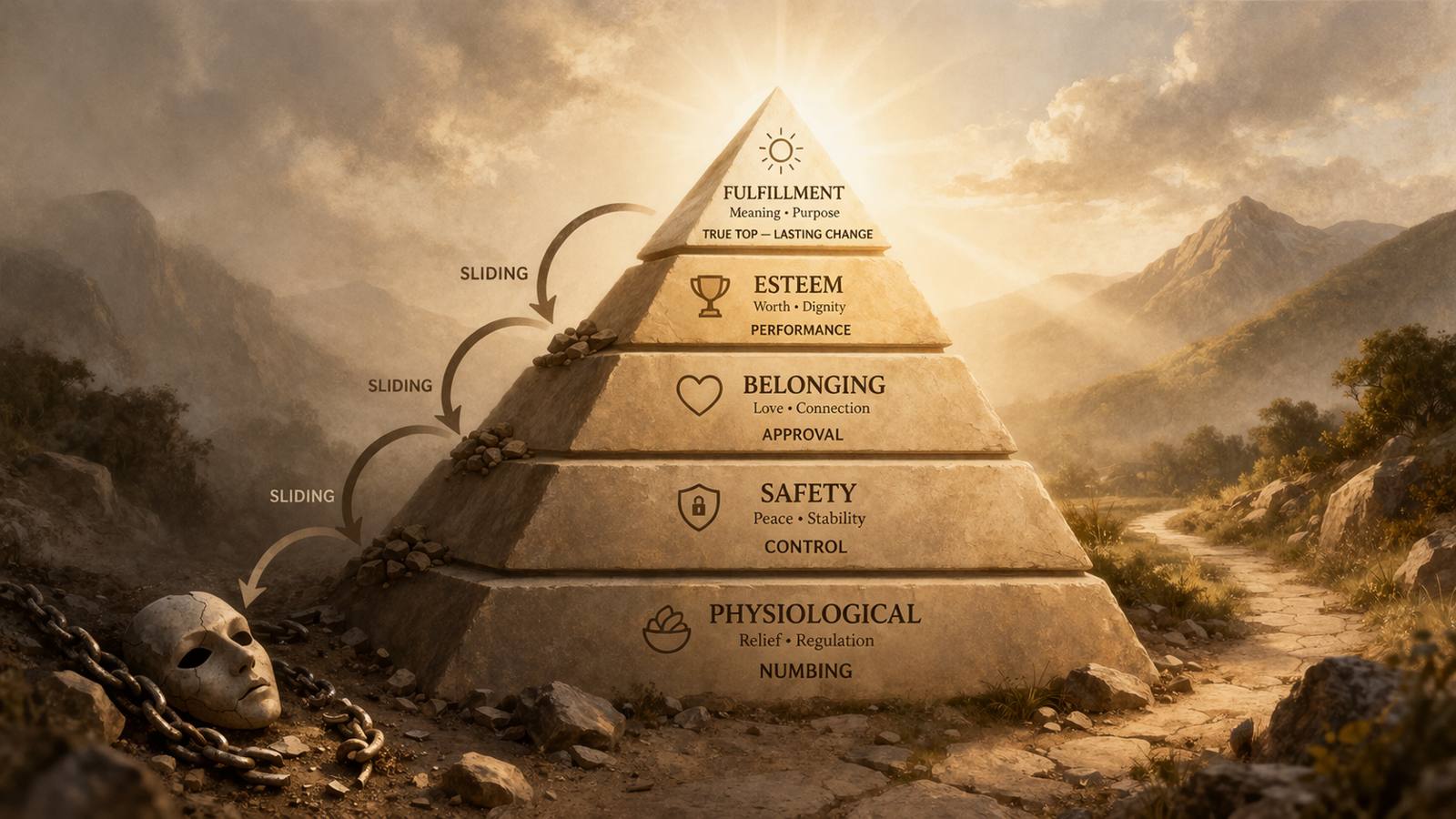
Maslow Isn’t a Ladder—It’s a Loop
Maslow’s hierarchy is usually taught like a staircase:
- physical needs
- safety
- belonging
- esteem
- fulfillment
But in real life, people don’t climb this once and move on.
They loop through it.
You can:
- have stability but still feel unsafe
- have relationships but still feel alone
- have success but still feel like you’re not enough
- pursue purpose and still feel empty
The issue isn’t whether the need exists.
It’s how we try to meet it.
The Substitutions We Make
At each level, we tend to replace real needs with easier substitutes:
- Relief → Numbing (food, alcohol, screens, distraction)
- Safety → Control (perfectionism, rigidity, overthinking)
- Belonging → Approval (people-pleasing, hiding, image)
- Worth → Performance (achievement, status, being right)
- Purpose → Self-Optimization (constant improvement, identity curation)
These substitutes aren’t random.
Most of them worked at some point. They helped us cope, survive, or feel okay for a moment.
That’s why we keep going back to them.
Why the Cycle Repeats
What starts as protection eventually becomes a pattern.
And then it becomes a prison.
The behavior isn’t the real issue. It’s the strategy behind it.
We’re trying to solve a real problem with something that can’t actually solve it.
So we get relief—but not resolution.
The Turning Point
Most people try to change by focusing on behavior:
“I need to stop doing this.”
That matters—but it usually doesn’t last.
A better question is:
“What need am I actually trying to meet?”
That question changes everything.
Because once you identify the real need, you can stop chasing substitutes and start moving toward something that actually works.
A Simple Way to Remember It
Don’t just fix the behavior.
Find the hunger beneath it.
That’s where real change begins.
Want to Go Deeper?
This is just the surface.
In the full article, we break down:
- how this cycle plays out at each level of Maslow’s hierarchy
- the specific patterns that keep people stuck
- how this connects to recovery, relationships, leadership, and identity
- and what it actually looks like to break the cycle