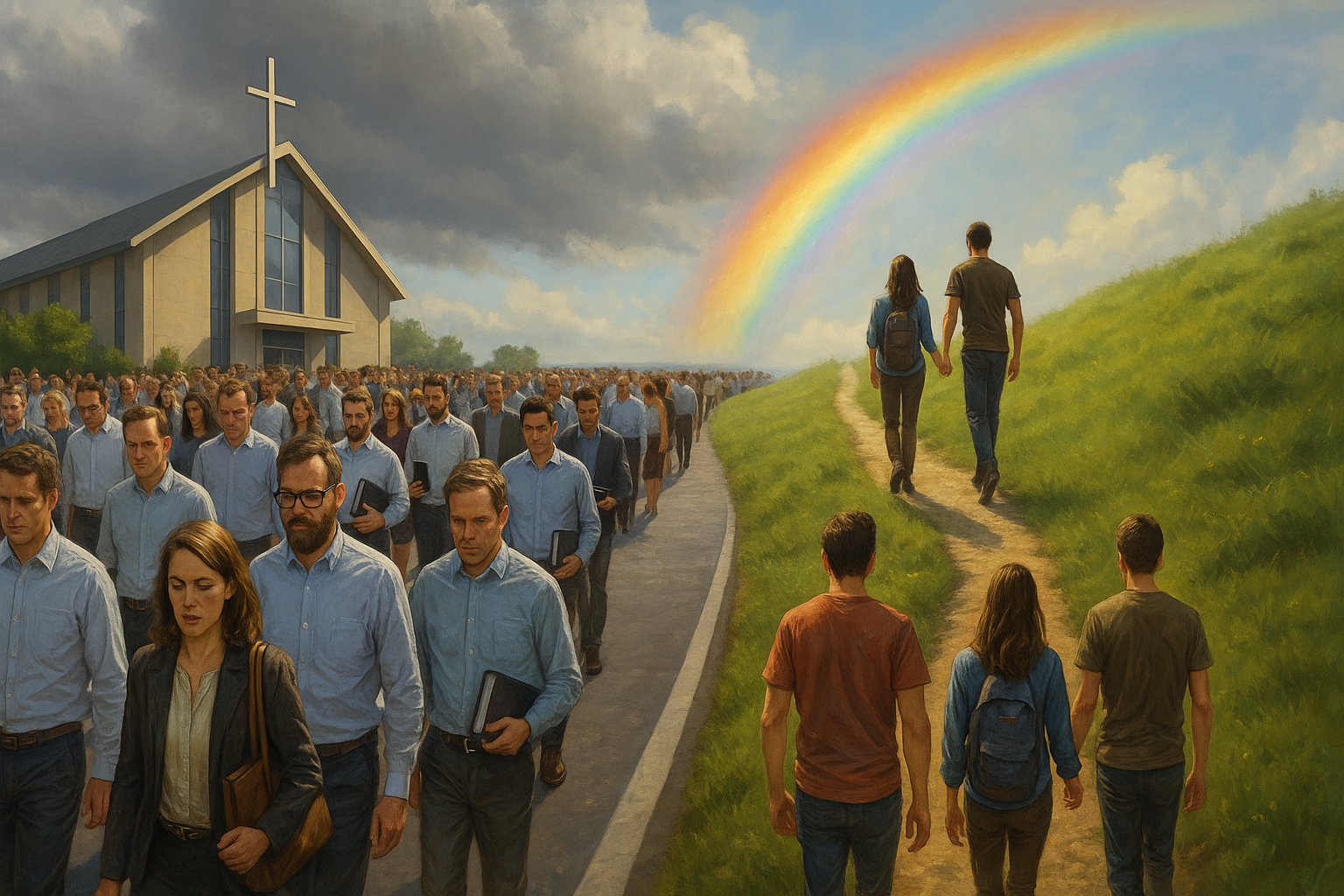
For generations, most people accepted school as a given. You went from kindergarten to 12th grade, possibly college if you could afford it, and then entered the workforce or the military. It wasn’t perfect—but it fit the world we lived in.
Families stayed put. Neighborhoods were stable. Even if you didn’t have much, there was a sense of rhythm and expectation.
That rhythm is gone.
🏚️ A Disconnected Culture
Today, many families rent rather than own. People move often. Extended families are scattered. And communities rarely feel like home.
Kids are growing up without the anchors that previous generations took for granted. Schools, once central to forming community, now feel more like institutions struggling to keep up than places of deep belonging.
🎓 What School Was—And What It’s Become
The school system was built to prepare children for a mostly stable world—where you’d grow up, get a job, start a family, and stay put.
But that world no longer exists.
Today’s students are taught to memorize for tests, not to think critically. They absorb information at lightning speed, but struggle to make meaning from it. They’re constantly evaluated but rarely seen.
In the past, education was designed to prepare children for life. Now it too often prepares them for bureaucracy.
🧠 From Wisdom to Performance
In a world where kids can Google any fact and get any answer from AI, the most valuable thing we can offer them isn’t more information—it’s wisdom.
But wisdom isn’t part of most curricula.
We measure everything except the things that matter most: character, self-awareness, empathy, curiosity, perseverance. And kids are left to figure out their values in a digital world that rewards spectacle over substance.
💻 The Pressure to Be Seen
Let’s be honest: if a kid isn’t the smartest, best-looking, most athletic, or most talented, the pressure to “stand out” doesn’t go away—it just finds a new outlet.
Online, attention is the new currency.
- In-game purchases signal status.
- Followers and likes shape self-worth.
- Identity becomes performance.
Kids aren’t becoming shallow. They’re becoming strategic. Because the system rewards those who can keep attention—not necessarily those with depth, truth, or talent.
It used to be impressive to drive a fast car. Today, if it’s not a Bugatti, nobody blinks. Our kids are being sold a version of success that’s both unrealistic and empty.
💸 More Money ≠ More Happiness
We’re not just facing an educational crisis. We’re facing a cultural illusion.
There’s compelling research—including a famous Princeton study—that shows once basic needs and a little comfort are met, additional income does not increase happiness.
But kids don’t see that on YouTube.
They see luxury. Influence. Flash. They believe happiness lives at the next level of status—and that if they’re not winning online, they’re falling behind in life.
And the real tragedy? Many adults believe it too.
🧠 Mental Health, Identity, and a Crisis of Formation
Meanwhile, schools are on the frontlines of a growing mental health crisis:
- Depression and anxiety rates are soaring.
- Suicide is one of the leading causes of death among teens.
- Students are being pulled between digital echo chambers, ideological confusion, and social isolation.
They’re told to be themselves, but rarely taught how to discover who that self really is.
Some parents are afraid to correct or guide their children—worried that any challenge to identity or belief could lead to emotional collapse. Others cling to rigid ideologies that don’t leave room for growth.
Children need presence, not polarization. They need room to question without fear—and room to grow without being pulled apart.
🔁 Kids Are Getting Propagandized from All Sides
Today’s youth are not just learning—competing forces are shaping them:
- Fundamentalist environments may reject science entirely, causing tension in classrooms where biology and geology are discussed.
- Ideologically driven content may affirm confusion as identity, discouraging discernment and deeper reflection.
- Schools feel pulled in all directions—trying to support, include, and instruct while walking a cultural tightrope.
Online, kids find people who will validate whatever they believe. That can be comforting—but it can also isolate them from necessary growth, healing, or challenge.
💰 An Expensive System That Isn’t Delivering
We spend more per student than ever before. But outcomes continue to decline. Why?
Because much of that money never reaches the people doing the real work:
- Teachers
- Support staff
- Aides
- Cafeteria workers
- Custodians
Instead, it goes toward:
- Administrative layers
- Testing and data tracking
- Tech platforms
- Outside consultants and trendy programs
- “Solutions” sold by organizations with profits in mind, not students
🌱 A Better Path: Community-Based Homeschooling
It’s time to rethink the entire model—not out of fear, but out of hope.
Community homeschooling isn’t about isolation. It’s about returning to what works:
- Learning through relationships
- Teaching life skills alongside math and language
- Letting curiosity guide discovery
- Mentorship from adults kids know and trust
- Learning environments rooted in values, not performance metrics
You don’t need to be perfect to try this. You just need to care. And you don’t have to do it alone—when communities share the load, everyone wins.
🧭 No Easy Answers—But A Willingness to Try
This isn’t about one ideology or solution. It’s about recognizing the deeper disconnect—and deciding to show up.
Kids don’t need more content. They need context.
They don’t need more lectures. They need listening.
They don’t need more metrics. They need meaning.
We can’t give them certainty about the future. But we can give them the tools to grow—and the relationships to steady them while they do.
That’s not just education. That’s formation.
Let’s stop waiting for someone else to fix the system.
Let’s begin building what our kids actually need.
Together.