
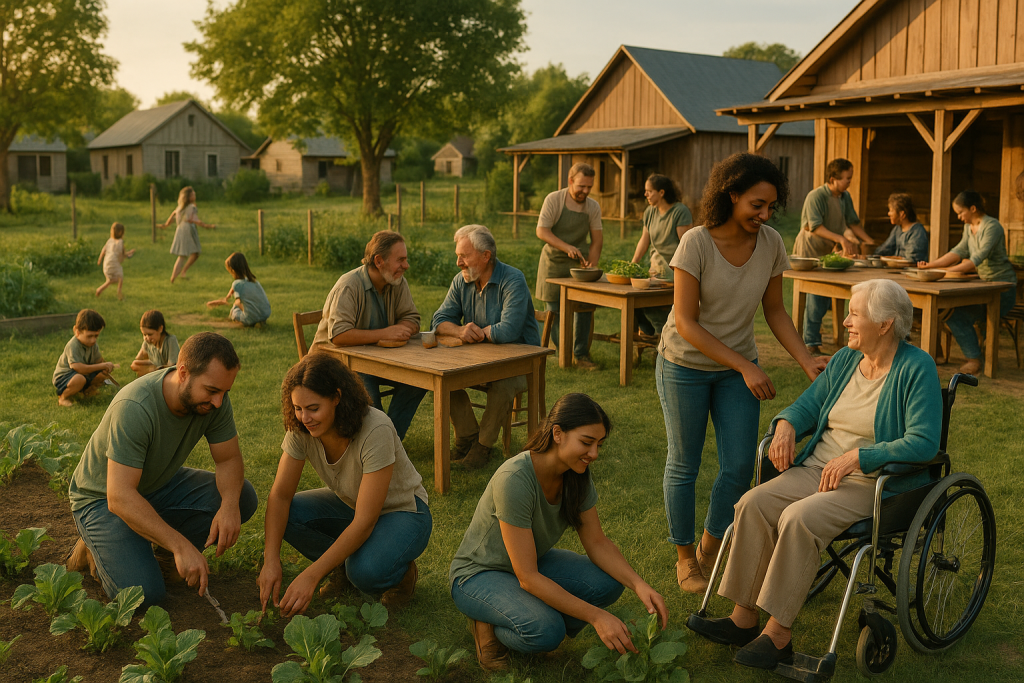
🧭 The Vision
Imagine a community where people recovering from addiction find meaningful employment, where seniors receive compassionate and affordable care, where families benefit from accessible childcare, and where every resident contributes to the common good.
Such a vision isn’t just possible—it’s economically transformative and profoundly beneficial to the fabric of our local communities. Our Holistic Renewal Community doesn’t just restore lives—it restores local economies, civic trust, and human dignity.
🚔 Reducing Incarceration Costs
Each year, the state spends between $31,000 and $60,000 per incarcerated individual. Roughly 65% of those in jail or prison suffer from substance use disorders or mental health challenges. Traditional systems often cycle individuals in and out without real healing.
Our community interrupts that cycle by offering stability: long-term housing, employment within micro-enterprises, access to integrated mental health care, and a strong, accountable support system. This reduces recidivism and allows people to reenter society with dignity—cutting costs for taxpayers while restoring lives.
🏠 A Transparent Alternative to Halfway Houses
Halfway houses are often plagued by a lack of oversight, high per-person costs, and minimal transformation. Most cost the government between $900 and $2,250 per month per resident and are known for their involvement in fraud and misuse of public funds.
We offer something radically better: transitional housing with full transparency, real accountability, and deep community integration—for just $600 to $1,000 per month. Our system utilizes blockchain-backed financial records and local oversight to ensure that every dollar is directed directly to resident support and rehabilitation.
👵 Revolutionizing Elder and Home Care
Elder care in America is both expensive and emotionally fragmented. Private home care often costs between $48,000 and $72,000 per year; however, much of this expense goes toward agency overhead rather than directly to the caregivers themselves.
Within our community, trained residents provide direct care at an average cost of $17,000 annually per elder. This not only reduces taxpayer burdens but also improves quality of life. Familiar caregivers create emotional continuity and genuine connection—something missing from most professional agencies.
👶 Affordable, Community-Driven Childcare
Childcare expenses can exceed $10,000–$15,000 per child annually, with government subsidies and vouchers placing additional strain on public budgets. Many parents are forced to choose between unreliable care and financial hardship.
Our model integrates childcare into the community’s fabric. Residents are trained and supported to care for children in nurturing, safe environments. This not only drastically lowers costs but also provides meaningful employment for caregivers and a strong support system for parents.
🌱 Sustainable Living and Economic Benefits
Our holistic model includes on-site farming operations—such as chicken coops, cow pastures, gardens, and crops—that provide fresh food to residents while creating a surplus for community sale. These initiatives reduce reliance on food stamps and federal nutrition assistance programs.
In addition, residents work with local businesses to provide skilled labor and services, establishing income streams that reduce dependency and empower self-sufficiency.
💛 Purpose-Driven Lives Create Healthier Communities
Research indicates that individuals who live with purpose tend to have longer lifespans, stronger immune systems, and improved mental health. This is especially true for retirees, formerly incarcerated individuals, and those recovering from addiction or trauma.
Our community is intentionally built around roles that matter—childcare, elder care, gardening, cooking, mentoring, and more. These contributions give each resident a reason to rise each morning and remind them that they are needed and valued.
💰 A Model of Accountability and Savings
The financial logic is simple: we eliminate unnecessary overhead, reduce dependence on jails, institutions, and state-run programs, and maximize the value of local donations and business partnerships.
This isn’t just a better way to spend—it’s a better way to live. Transparent, relational, and rooted in the common good.
Let’s build the kind of village that makes both moral and fiscal sense.
Together, we can.