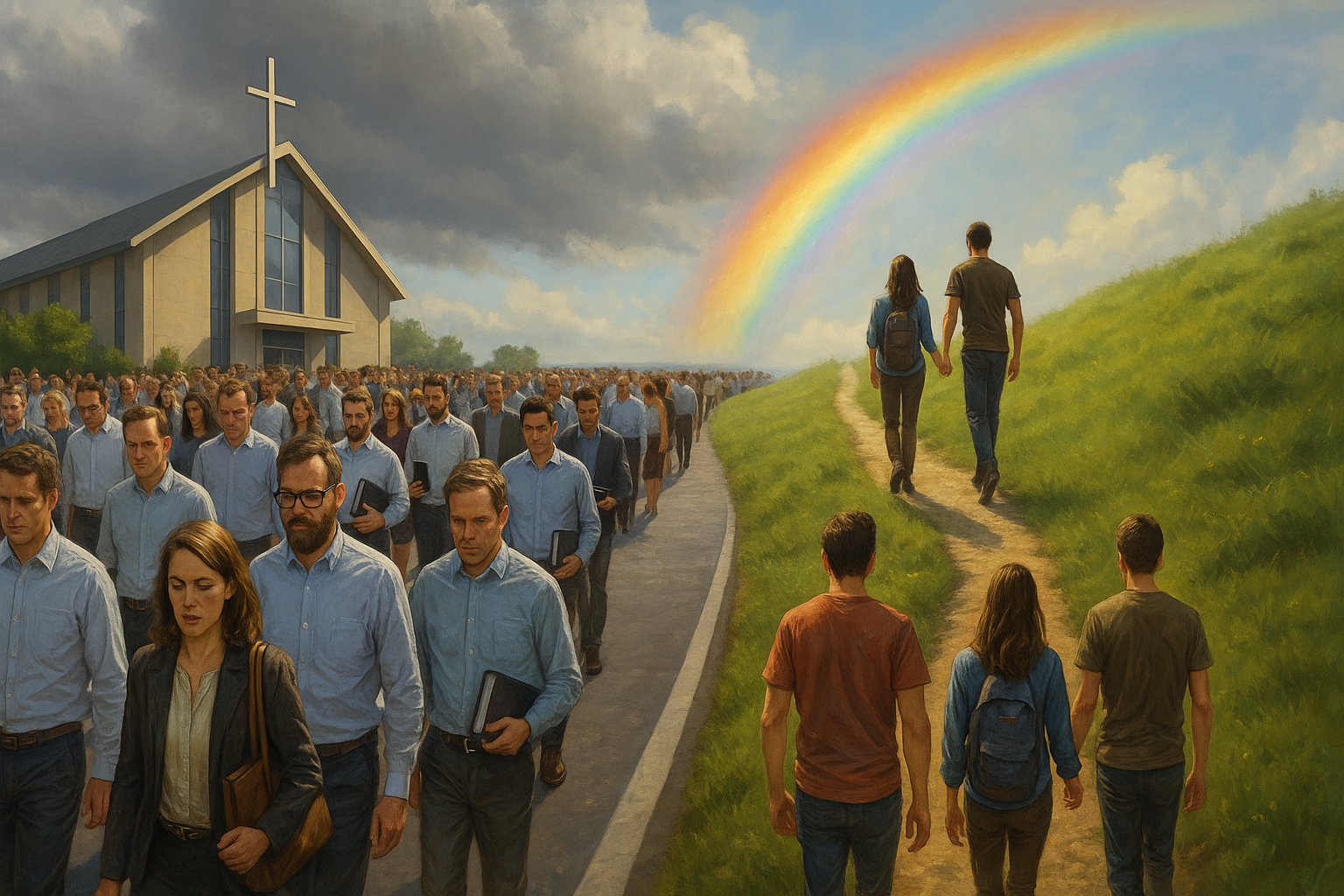
In a world saturated with screens, algorithms, and artificial intelligence, the very word “spirit” can feel outdated—like a leftover from a pre-scientific age. For some, it conjures up images of ghosts or supernatural forces. For others, it’s been reduced to metaphor: “team spirit,” “spiritual but not religious,” or a vague sense of emotional uplift.
But what if spirit is something far more real, more necessary, and more urgent than we’ve dared to consider?
A growing chorus of modern thinkers—philosophers, theologians, scientists, and mystics—are returning to this ancient question with new clarity. Thinkers like John Vervaeke, Jonathan Pageau, and others across traditions are challenging the modern assumption that spirit is imaginary or metaphorical. Instead, they argue that spirit is an ontological category—a foundational layer of reality, woven into the very structure of life, consciousness, and community.
This article explores that vision.
The Problem of a Flat World
Modernity gave us many gifts—medicine, science, technology, and unprecedented material comfort. But it also flattened our understanding of reality. What couldn’t be measured, categorized, or commodified was often dismissed as unreal or unimportant.
Spirit, along with beauty, love, and meaning, was pushed to the sidelines—relegated to the private sphere, or translated into brain chemicals and evolutionary adaptations.
In the process, we didn’t just lose “religion.” We lost the language of participation—a way of being-in-the-world that sees humans as part of a larger, living order. We began to see ourselves not as stewards of meaning but as isolated minds in meaningless matter.
But cracks are forming in this reductionist view. And spirit is re-emerging—not as a ghost, but as the binding force of coherence.
From Substances to Relations
To understand this shift, we have to go deeper than religious belief or emotional experience. We need to look at ontology—the question of what truly “is.”
Western thought has long been built on substance ontology: the idea that the world is made of individual things with fixed properties. This model works well in physics and chemistry, but it falls apart when we try to explain life, mind, or community.
Neoplatonic thinkers offer an alternative: relational ontology. In this view, being itself is relational, not static. Things don’t exist in isolation—they exist through their participation in patterns, meanings, and purposes. The “One” (in Neoplatonism) is not just a big thing at the top of a hierarchy—it is the source of unity that allows things to be coherent at all.
In this model, spirit is not an added layer—it is the organizing principle of life.
Spirit as Living Coherence
Think about a rabbit. A living rabbit is a unified whole. It eats, moves, reproduces, and flees danger. It acts with purpose. A dead rabbit, however, is the same matter—same fur, bones, cells—but it is no longer a rabbit in the same sense. It’s parts.
What’s the difference? Not a thing, but a pattern. A coherence. A principle of organization. That principle—what animates the parts into a unified, purposeful being—is what ancient traditions called spirit.
Spirit, then, is not a floating soul trapped in a body. It is the binding intelligence of the whole. The breath that gives life. The reason why your cells are you and not just atoms in a bag.
The Hebrew word for spirit is ruach—meaning breath, wind, or animating presence. The Greek word is pneuma. Both imply movement, vitality, and connection. Spirit is the life of the whole, expressed through its parts.
Fellowship as Ontology
If spirit is what binds parts into a living whole, then fellowship—our human capacity to bond, empathize, and act together—is not just a social phenomenon. It’s an ontological act.
When two or more people come together in shared love, purpose, or ritual, they don’t just cooperate. They form a new level of reality—a “we” that cannot be reduced to individual “I”s. This is what Vervaeke and Pageau call the fellowship of the spirit.
You can feel it in a sports team “in the zone.” In a group of mourners moving through grief. In a congregation gathered in reverence. Something emerges that is more than the sum of its parts, yet fully dependent on each.
This fellowship is not just emotional or symbolic. It is the emergence of shared agency. It has causal power. It can forgive, create, endure, and transform.
Spirits as Patterns, Not Ghosts
So what about angels? Demons? The “spirit of the age”? Are these just fantasies?
Not necessarily. If spirit is the pattern that animates a system, then spiritual beings can be understood as patterns that act across multiple lives.
A “spirit of envy” can infect a workplace. A “spirit of reconciliation” can sweep through a family. These are not hallucinations—they are real phenomena if they reliably shape behavior, evoke responses, and organize experience.
Modern science calls this “distributed cognition” or “emergent systems.” Ancient traditions called them powers, principalities, and spirits.
They are real. Not because they live in another dimension, but because they live through us.
The Imaginal Realm: Where Spirit Touches the World
Between fact and fiction, there is a third realm: the imaginal.
This is the space of stories, archetypes, symbols, and dreams. It’s not unreal—but it’s not reducible to neurons or chemicals either. The imaginal is a real mode of knowing—where truth is disclosed through meaning, rather than measurement.
You’ve touched it if a story changed your life. If a song gave you courage. If a ritual made you weep. This is the realm where spirit speaks—not in data, but in beauty and coherence.
In a disenchanted world, we must recover the imaginal—not as escapism, but as the very terrain where meaning incarnates.
AI, Personhood, and the Loss of Spirit
In a strange twist of history, we now have machines that can simulate empathy, write poetry, and hold a conversation. Artificial intelligence is advancing rapidly. But in our rush to celebrate its power, we risk losing the plot.
AI has no breath. It has no memory of birth, no awareness of death, no moral horizon beyond its training data. It mimics personhood but cannot participate in the fellowship of the spirit.
That’s not just a technical limitation—it’s an ontological difference. A person is not a sum of functions. A person is a center of presence, bonded to others in real time, through body, meaning, and vulnerability.
Spirit cannot be coded. It must be shared.
Liturgy as Technology of the Sacred
So how do we access spirit in a disenchanted world?
One way is through liturgy—not just in church, but in any embodied, shared ritual that makes space for the sacred.
Liturgy isn’t magic. It’s a pattern that opens the heart to presence. A way of synchronizing body, mind, and community to receive meaning. Whether it’s communion, shared meals, foot-washing, or even music—liturgical acts make spirit visible.
They remind us that we are more than consumers, critics, or isolated minds. We are participants in a shared reality, a living cosmos, knit together by breath, love, and presence.
A Return, Not a Rewind
None of this means abandoning science or progress. It means going through modernity and coming out the other side—reclaiming what was lost without denying what we’ve learned.
It means returning to spirit—not as superstition, but as the deep grammar of reality.
We are not alone. We are not just chemicals. We are not meant to be cogs in a machine. We are animated, breathing creatures, made for love, meaning, and communion.
And spirit—the breath that unites—has been here all along.
Let’s make space again for the sacred in our midst. Not by escaping the world, but by re-seeing it—breathing together, walking together, remembering together what it means to be truly alive.
These concepts are discussed in this video: