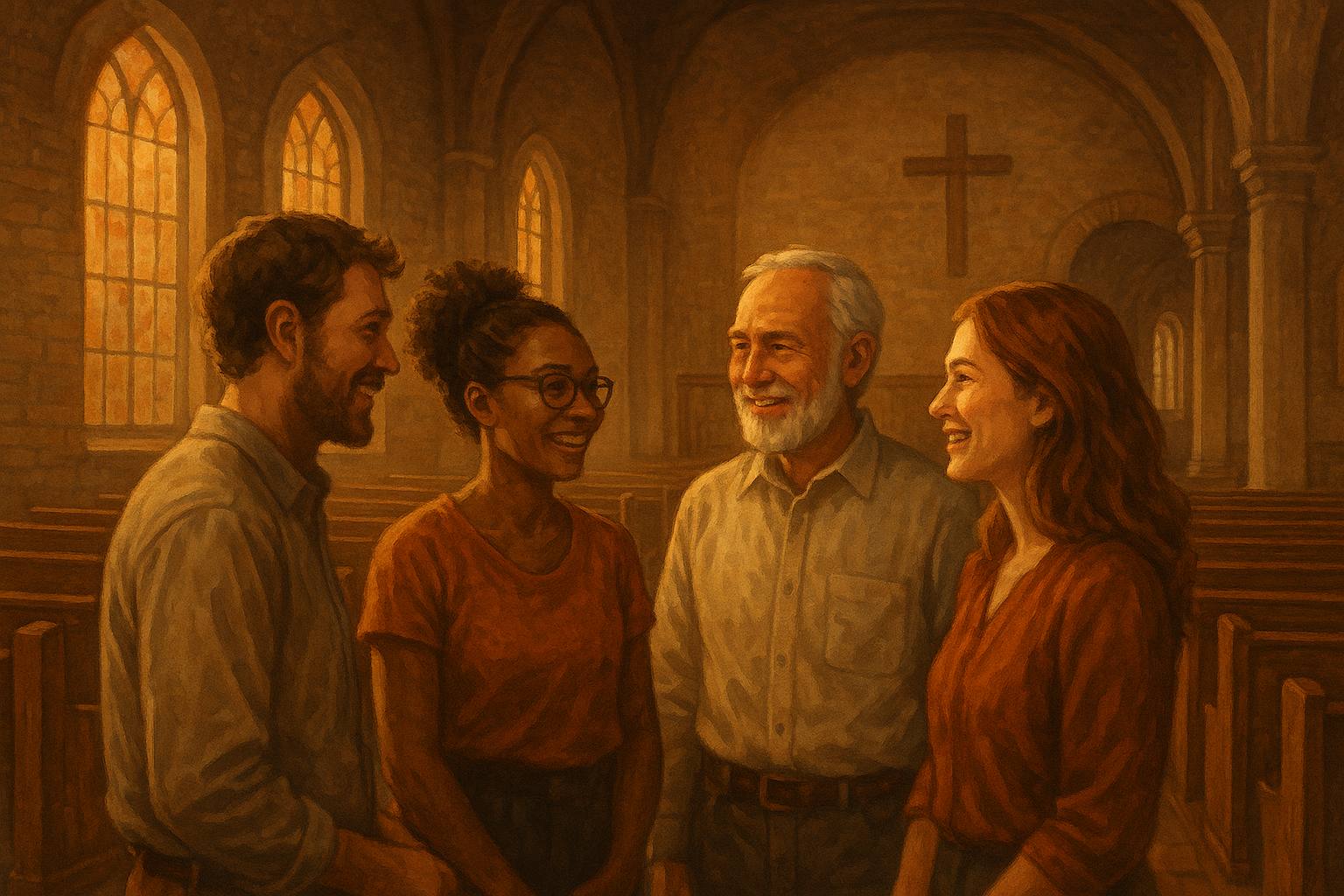
Throughout history, Christian churches have undergone significant transformations—from intimate home gatherings of early believers to influential societal institutions that provide education, healthcare, and various community services. Today, many churches have narrowed their focus, often emphasizing doctrine and spiritual preparation for the afterlife over tangible, earthly community support. All Common Ground seeks to address this shift, fostering a renewed emphasis on practical, compassionate community involvement.
Early Church: Simple Gatherings and Shared Lives
The earliest Christian churches were humble, often gathering in homes, where worship was intimately intertwined with everyday life. Communities pooled resources, shared meals, and took care of each other’s physical and emotional needs, embodying the idea of the church as a living, communal organism. These gatherings were small and relationship-driven, rooted deeply in the principles of mutual aid and compassion.
This early communal spirit is captured vividly in the Book of Acts:
“And all who believed were together and had all things in common. And they were selling their possessions and belongings and distributing the proceeds to all, as any had need.” (Acts 2:44-45, ESV)
However, it is essential to clarify that All Common Ground does not require or encourage anyone to sell all their possessions or relinquish their individual autonomy to join our community. We are not a cult. Rather, we emphasize the spirit of generosity, mutual support, and collective well-being that this passage symbolizes.
Institutionalization and Community Leadership
Over the centuries, Christianity institutionalized. Churches erected buildings that became focal points of towns and villages, deeply integrated into community life. They provided essential services, including:
- Education: Churches established schools, nurturing literacy, knowledge, and civic responsibility.
- Healthcare: Monasteries and church-run hospitals offered care for the sick, poor, and vulnerable.
- Social Services: Churches lent money, land, and resources, effectively acting as early forms of banks and social support systems.
Historically, usury—charging excessive or even any interest—was prohibited by religious law, recognizing how harmful and exploitative debt could become. Imagine the societal benefits if churches today helped their members secure homes without profiting from interest. The overwhelming debt burden and predatory financial practices, such as “buy now, pay later” services, could be significantly reduced if local churches or trusted community leaders offered responsible, interest-free loans. All Common Ground proposes practical support through small, interest-free loans specifically for immediate, genuine needs—not discretionary spending like an Uber Eats delivery.
Shift Toward Secular Institutions
With industrialization, modernization, and secular governance, churches gradually ceded many responsibilities to businesses and government entities. Public schools, hospitals, banks, and welfare programs now handle roles historically managed by churches. Consequently, churches have become increasingly inward-focused, primarily concerning themselves with doctrinal purity and spiritual teachings.
At the same time, many modern churches now invest millions in the latest technology—high-end audio/visual systems, studio-quality production for livestreams, podcasts, YouTube channels, and an omnipresent social media strategy. Ironically, these tools, while expansive in reach, can often diminish the depth of real-life connection. The spectacle can replace the substance. Instead of serving their local neighborhood, churches are building global brands.
Worse, many churches have become incubators for multi-level marketing (MLM) schemes. From essential oils to vitamin supplements to insurance pyramids, congregations are often viewed as ready-made networks for personal profit. The blending of spirituality and salesmanship erodes trust and community.
Even some of the most respected voices in Christian financial advice are not immune to controversy. Dave Ramsey, widely regarded as a Christian financial guru, was sued for endorsing a timeshare exit company, Timeshare Exit Team. Plaintiffs allege that Ramsey received millions in undisclosed kickbacks while promoting a service that ultimately failed to deliver for many desperate clients.
These examples reveal how far the modern church has strayed from its roots. Where the early church shared resources and lifted burdens, today’s version often multiplies them under the banner of growth, success, or digital engagement.
Fragmentation and Isolation
Today’s Christian landscape is marked by denominational divisions and doctrinal disputes. These divisions have caused believers to isolate into distinct congregations based on nuanced theological differences, significantly limiting their ability to collectively address broader community needs. The focus on individual salvation and strict adherence to dogma has often overshadowed collective, compassionate action.
“Heavenly Minded, No Earthly Good”
The contemporary evangelical approach, particularly the “Hellfire” Gospel, often emphasizes fear and judgment rather than practical love and service. Such messaging can alienate individuals, making churches appear disconnected from everyday human concerns. This inward, doctrine-heavy focus detracts from active, compassionate community engagement and leaves a gap in society’s fabric, once woven tightly by active church involvement.
All Common Ground: Bridging the Gap
All Common Ground seeks to restore what the church has gradually abandoned. Recognizing that lasting growth, community healing, and societal improvement come through humility, dialogue, and direct engagement, All Common Ground emphasizes:
- Community First: Prioritizing the creation of genuine connections and supportive environments over doctrinal uniformity.
- Understanding Over Winning: Facilitating compassionate conversations rather than doctrinal debates.
- Practical Compassion: Re-engaging with community needs, such as healthcare, childcare, senior care, addiction recovery, and economic support, directly reflecting the early church’s spirit.
By redirecting resources otherwise fragmented by denominational divisions and doctrinal disputes, All Common Ground demonstrates how pooled community effort can address real-world problems effectively. It moves beyond theoretical salvation into actionable community salvation—rooted deeply in genuine human connection and service.
A Call to Action
The evolution of Christian churches from vital community hubs to insular institutions highlights the urgent need for reintegration and realignment with core compassionate principles. All Common Ground invites believers of all backgrounds to embrace a shared humanity and collective responsibility, renewing the church’s historical role as a profound force for societal good—grounded, compassionate, and deeply connected to the daily lives and struggles of real people.
Through courageous dialogue and community-centered action, All Common Ground offers a model where spiritual ideals meet practical needs, bridging divides and restoring the essential, earthly mission of genuine community.