
A neighbor can become a symbol before we notice it happening.
Someone we know from work, church, the school pickup line, or the house down the road says one thing about politics. Suddenly we are no longer hearing a whole person. We are hearing a category. Their vote tells us what kind of heart they must have. Their news source tells us whether they can be trusted. A single position begins to stand in for their character.
That shift is easy to recognize in other people. It is harder to catch in ourselves.
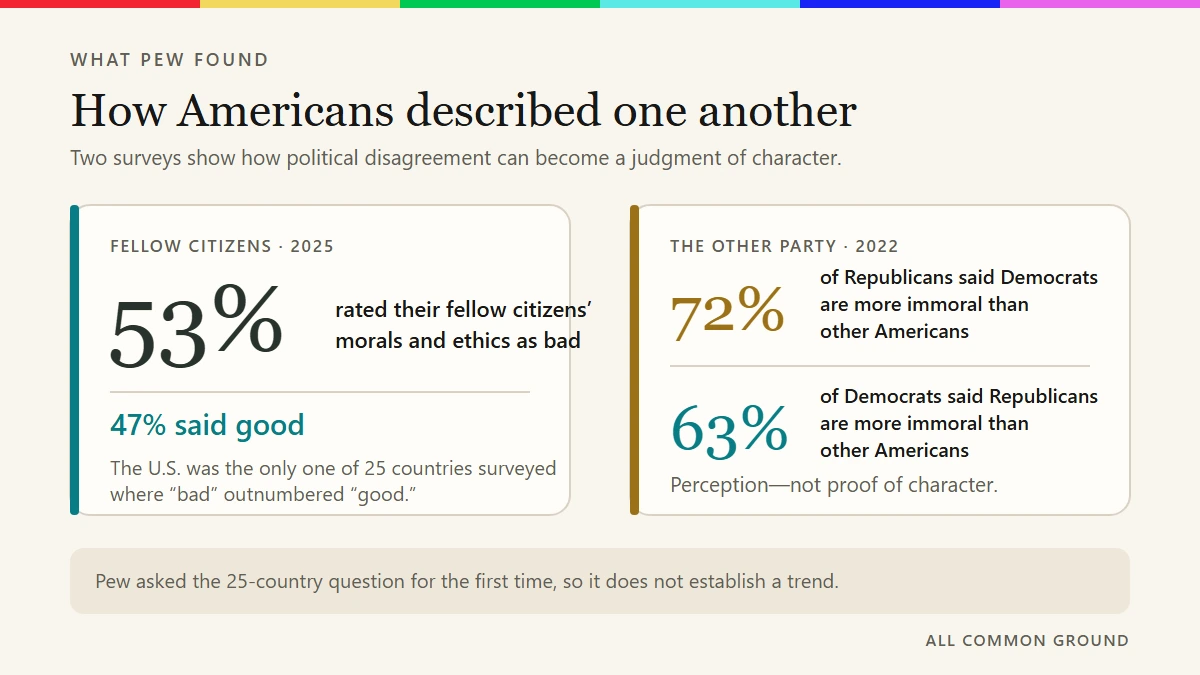
In a 2025 survey across 25 countries, Pew Research Center found that the United States was the only country surveyed where more adults described the morals and ethics of their fellow citizens as bad than good: 53% to 47%. Pew was careful about what that result could establish. It was the first time the organization had asked the question, so it could not say whether this was a new American condition or a longstanding one.
But an earlier Pew study found something related. In 2022, 72% of Republicans described Democrats as more immoral than other Americans, while 63% of Democrats said the same of Republicans.
This is more than disagreement. It is moral distrust.
Once we believe the people across from us are not merely mistaken but bad, listening begins to feel irresponsible. Compromise feels like surrender. Contempt starts dressing itself up as courage.
Fear likes a simple story
Real life is complicated. Fear is not.
When the bills keep rising, work feels uncertain, institutions lose credibility, families are strained, or the culture seems to be changing faster than we can understand it, a simple story can feel like relief:
They did this. We are the ones who see it. Defeat them, and things will make sense again.
That story can arrive from the left or the right, from a politician or a preacher, from a cable network or an independent creator. The cast changes. The structure does not.
This does not mean every disagreement is manufactured or that every fear is irrational. Some policies genuinely hurt people. Some conduct deserves a firm no. Economic pressure, religious conviction, history, race, status, institutional failure, and personal experience all matter. No single explanation accounts for the division around us.
But fear can narrow what we are willing to believe about one another. It can make certainty feel like shelter and belonging feel like proof.
In a video that helped sharpen this article, Tom Bilyeu put the challenge plainly: “Refuse the enemy that they try to hand you.”
That does not require pretending there is no wrongdoing in the world. It asks us to notice the moment we reduce a person to a position—and begin treating that person as someone we are permitted to hate.
The team reflex is human
We like to imagine that facts enter our minds, get weighed fairly, and produce a conclusion. Sometimes they do. But reasoning becomes more complicated when a conclusion threatens our identity or belonging.
In a small 2006 brain-imaging study, researchers gave 30 committed partisans reasoning tasks involving contradictory information about their preferred presidential candidate, the opposing candidate, and neutral figures. Their findings were consistent with motivated reasoning when political identity was at stake.
The study does not prove that politics switches off the brain. It does not show that one party is uniquely irrational. And it does not mean a conclusion must be false simply because emotion is involved. Thirty people in an fMRI scanner cannot carry that much weight.
What it does offer is a useful warning: when belonging is involved, our minds may be doing more than asking, Is this true? They may also be asking, What will it cost me if this is true?
Will I disappoint my friends? Lose standing in my church? Betray the people who trust me? Have to admit that someone I opposed was right—or that someone I defended was wrong?
Intelligence does not place us beyond that pressure. It can give us sophisticated language for protecting the conclusion we already wanted.
The warning is not that they are irrational. It is that we are vulnerable too.
The feed turns a reflex into a loop
Social media did not create our need to belong. It learned how to measure it.
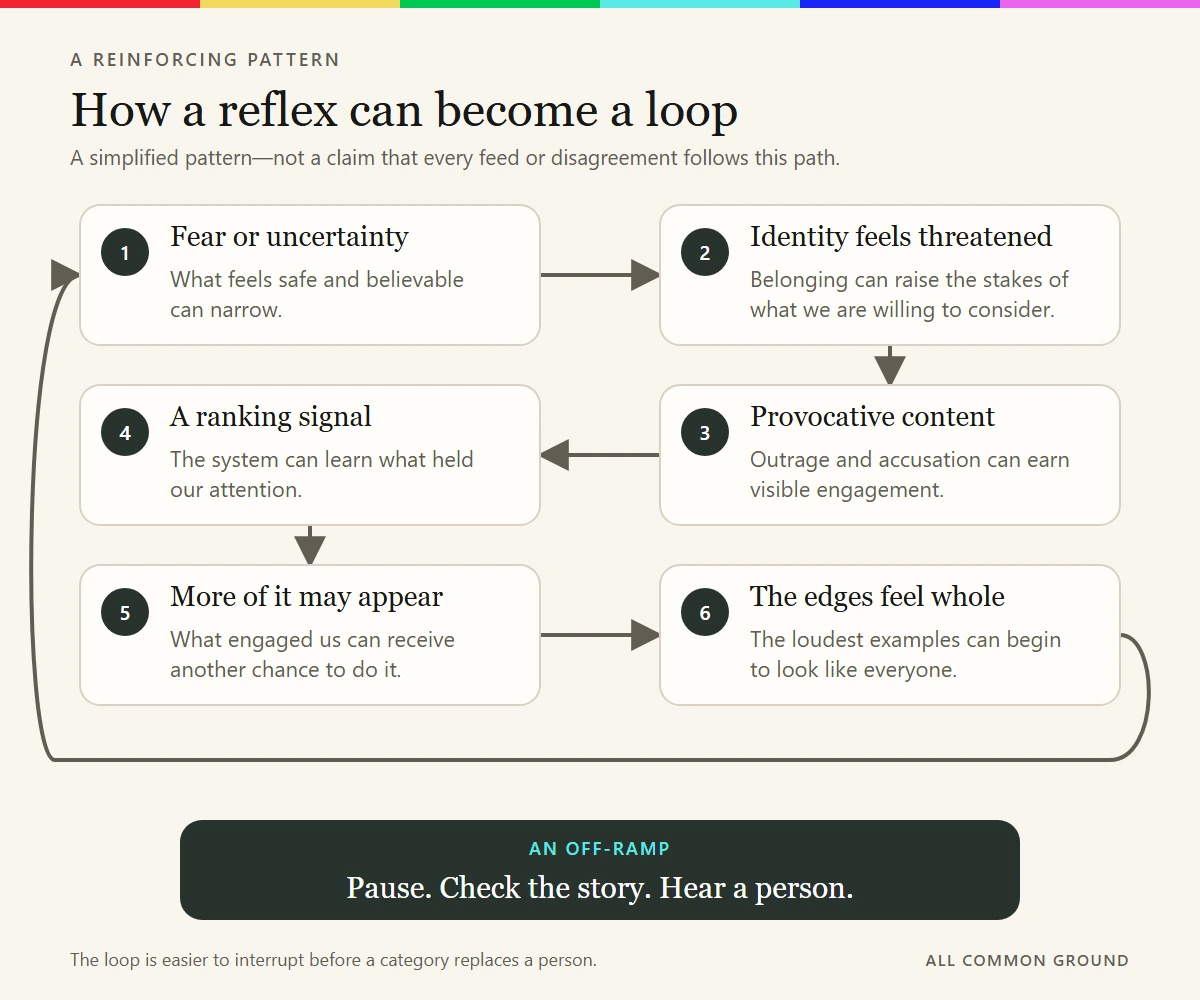
A feed is not simply a window showing us everything that was posted. It is a ranking system making constant predictions about what will keep us engaged. Meta explained this logic openly when it reworked Facebook’s News Feed in 2018: reactions, comments, shares, and predicted conversation all helped determine what appeared higher.
That sounds reasonable. Often it is useful. A friend asking for help or a family conversation can generate exactly the kind of interaction people value.
But interaction is not the same thing as wisdom. A careful explanation may earn a quiet nod and a scroll. An insult can produce a hundred furious comments. A complicated truth may ask for patience; a frightening accusation asks only for a click.
The system does not have to hate us or understand us. It only has to notice what reliably earns our engagement.
That is why the most honest conclusion is not “social media is evil.” These platforms connect distant families, help local businesses find customers, and surface work that deserves to be seen. The narrower—and stronger—claim is that ranking for engagement is not the same as ranking for truth, proportion, or human flourishing. When provocative content produces the clearest behavioral signal, the feed can make the edges look like the whole world.
We explore that mechanism more fully in How Algorithms Shape Our Perspectives and Why Common Ground Gets Overlooked.
Explanation is not an excuse
If fear, identity, and social pressure help explain division, it can sound as though no one is responsible for anything. That is not the conclusion.
Understanding why a person reaches for certainty does not require approving what they do with it. Compassion does not mean silence in the face of cruelty. Listening does not obligate us to call a harmful idea harmless.
Diagnosis matters because contempt is a poor instrument of change. If fear is helping drive a belief, humiliation can give the fear more evidence. If belonging is holding a position in place, public shame can push the person deeper into the group that still welcomes them.
We can hold a boundary and remain curious about what is underneath the behavior. We can challenge an idea without pretending the person who carries it has become the idea.
That is not softness. It is accuracy.
Beyond teams does not mean standing for nothing
All Common Ground is not an argument that the middle is always right. The midpoint between two claims is not automatically true, and looking for complexity does not make unequal conduct equal. The truth may lie between us, beyond both of us, or mostly on one side of a particular question.
Going beyond teams means something more demanding: refusing to outsource our conscience to the people wearing our colors.
It means applying the same moral standard when our side holds power and when it does not. It means being willing to recognize truth in a person we distrust and wrongdoing in a person we admire. It means remembering that every story has at least three sides—mine, yours, and the truth neither of us sees completely.
Conviction still matters. So does humility. We need both if we want clarity without cruelty.
Four questions before we react
We may not be able to reason our way completely outside the team reflex. We can still interrupt it.
Four questions can help:
- What am I protecting right now? A principle, a person, my reputation, my group, or my need to feel certain?
- What do I know—and what story have I added? Which part is documented fact, and which part is my interpretation of motive?
- Would I judge this the same way if my own side did it? If not, what is changing my standard?
- Have I asked what concern, experience, or value sits underneath the other person’s position? Not to explain it for them, but to understand it in their own words.
Sometimes those questions strengthen our original conviction. Sometimes they expose a double standard. Often they simply slow us down long enough to see a person again.
That pause is part of the Common Ground Way: listen to understand, speak from our own experience, and challenge ideas without reducing people to them.

A table makes fear less profitable
An article can help us name the pattern; it cannot heal it by itself. Information was never going to be enough.
The deeper answer is relationship—the kind that makes it harder to turn a neighbor into a symbol. A feed can sort us by what provokes us. At a table, the category gives way to a name, a face, a family, a history, and a voice that will not fit inside a headline.
Relationship does not guarantee agreement. What it changes is the cost of contempt.
When we have eaten with someone, heard what they are afraid of, helped when their family was struggling, or watched them show up for ours, the story of an enemy has to compete with a real human being. That is one reason local community matters so much. Shared meals, shared work, honest conversation, practical help—these are not escapes from the larger crisis. They are some of the few places where the machinery of division loses its advantage.
We may not be able to repair every institution or settle every national argument. We can practice the kind of local relationship that makes fear less profitable. We can refuse to let a team tell us whose humanity no longer counts.
That is what we are trying to practice when we gather: not a debate stage and not a demand that anyone surrender conviction, but a table where people can speak honestly, listen without being reduced to a label, and remain neighbors.

If you are tired of being handed enemies and ready for a different kind of conversation, learn about gathering with us or read the Common Ground Way.
Different views. Shared humanity. Real community.
Sources and further reading
- Jonathan Evans et al., Pew Research Center, “In 25-Country Survey, Americans Especially Likely To View Fellow Citizens as Morally Bad”, March 5, 2026. The survey was fielded in 2025; Pew notes that this was its first time asking the question and therefore does not establish a trend.
- Pew Research Center, “Republicans and Democrats increasingly critical of people in the opposing party”, August 9, 2022.
- Drew Westen et al., “Neural bases of motivated reasoning: an fMRI study of emotional constraints on partisan political judgment in the 2004 U.S. Presidential election”, Journal of Cognitive Neuroscience 18, no. 11 (2006): 1947–58.
- Meta, “Bringing People Closer Together”, January 11, 2018.
- Tom Bilyeu / Impact Theory, “It’s Not Right Vs Left… THIS Is The Real Reason For Division…” This article draws on the video’s diagnosis of fear, group loyalty, and dehumanization without adopting all of its historical framing or policy conclusions.